The Urban Grid vs. The Soi System: A Strategic Guide to Neighborhood Selection in Toronto vs. Bangkok
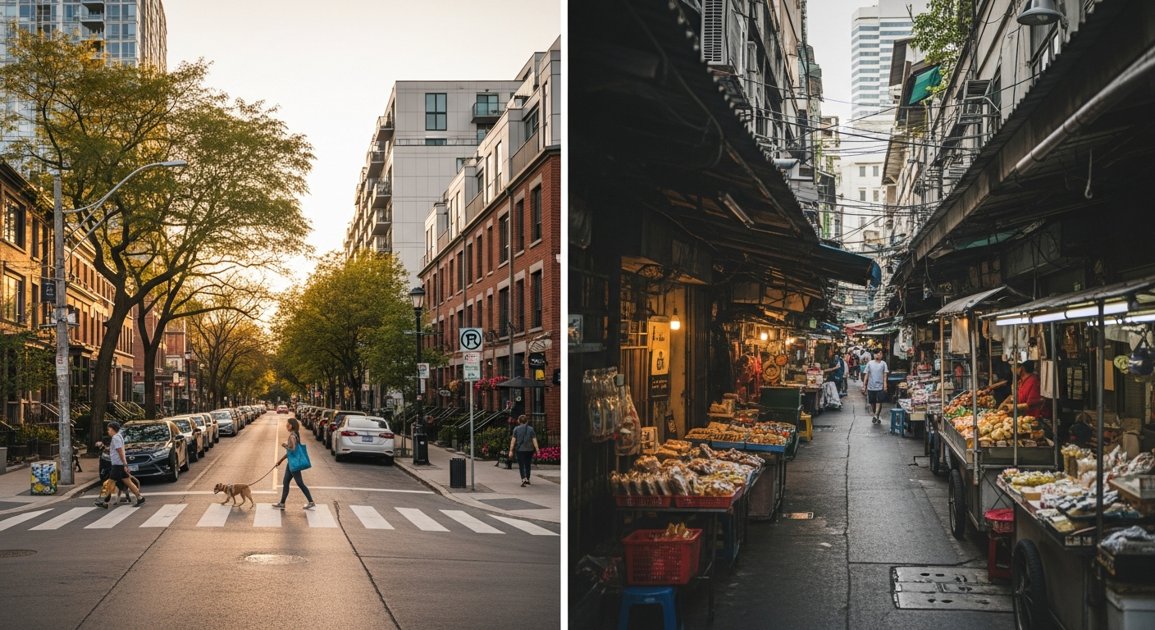
For a Torontonian, the city is a predictable chessboard. Whether you are navigating the Annex or Liberty Village, the logic of the grid—North, South, East, West—is your north star. But step off a plane in Bangkok, and that internal compass will spin. You are no longer in a grid; you are in a biological system of arteries and capillaries known as the Soi system. Moving from the orderly blocks of the 6ix to the winding lanes of the Big Mango requires more than just a map; it requires a shift in how you perceive urban space.
Toronto’s Urban Grid: The Logic of the Square
Toronto’s layout is largely a product of 19th-century British surveying. The result is a highly permeable urban fabric where if one street is blocked, you can simply move one block over and continue your journey. This predictability makes neighborhood selection relatively straightforward for Canadians.
Walkability and Transit Permeability
In Toronto, "walkability" is often synonymous with "main street living." If you live near a subway station on the Bloor-Danforth line, you expect a consistent level of infrastructure—sidewalks, streetlights, and retail—extending in every direction. The grid allows for a high degree of transit-oriented development (TOD) where density is evenly distributed around transport hubs.
Bangkok’s Soi System: Navigating the Labyrinth
Bangkok is built differently. The city grew along canals (khlongs) that were later paved over, creating a system where massive "super-blocks" are serviced by a single main road (Thanon). From these main roads, smaller side streets—called Sois—branch out like tree limbs. Many of these sois are dead ends (Soi Tan), meaning the permeability Toronto residents take for granted simply doesn't exist here.
The ‘Deep Soi’ vs. ‘Main Road’ Trade-off
In Bangkok, your distance from the mouth of the soi determines your lifestyle. Living at the "top" of a soi near a BTS (Skytrain) or MRT (Subway) station offers unparalleled convenience but comes with the noise and pollution of heavy traffic. Living "deep" in a soi offers a quiet, village-like atmosphere, but requires a strategic approach to daily commuting.
- The Win: Deep sois often house hidden gems—local cafes, cheaper street food, and lush greenery that you won’t find on the grid.
- The Challenge: Sidewalks are often non-existent or obstructed, making the "last mile" of your commute a challenge in the tropical heat.
Strategic Selection: A Step-by-Step Guide for Canadians
To find the right neighborhood in Bangkok, you must stop thinking in terms of blocks and start thinking in terms of transit nodes and soi depth. Here is how to approach your search:
- Identify Your Primary Transit Line: If you work in Sukhumvit, stick to the BTS Green Line. If you frequent the historic center or the riverside, the MRT Blue Line is your best bet. Unlike Toronto’s interconnected TTC, switching between lines in Bangkok often requires a separate ticket and a long walk.
- Measure the "Last Mile": Use a mapping tool to check the distance from the station to your potential condo. Anything over 500 meters in 35-degree humidity feels much longer than it does in a Toronto autumn.
- Check for Motorbike Taxi Stands: Look for the "Orange Vests." In Bangkok, the motorbike taxi is the solution to the soi system. If your building isn't near the station, ensure there is a reliable stand nearby to whisk you to the main road.
- Assess the Flood Risk: Because the soi system lacks the uniform drainage of a grid, certain low-lying sois flood quickly during the monsoon season. Always ask locals or check community forums about "water management" on that specific street.
Plan Your Move with Precision
Deciding between the familiarity of the Toronto grid and the vibrant complexity of Bangkok’s sois is a major life decision. You don't have to guess which neighborhood fits your lifestyle. The NewLife.Help comparison tool analyzes your preferences—from walkability and transit needs to budget and local amenities—to provide a personalized relocation report in seconds. Start Your Free Relocation Analysis
Transitioning from the orderly streets of Toronto to the organic sprawl of Bangkok is an exercise in adaptation. While the grid offers predictability, the soi system offers discovery. By understanding the structural DNA of your new home, you can stop fighting the layout and start enjoying the unique rhythm of life in one of the world’s most dynamic metropolitan hubs.